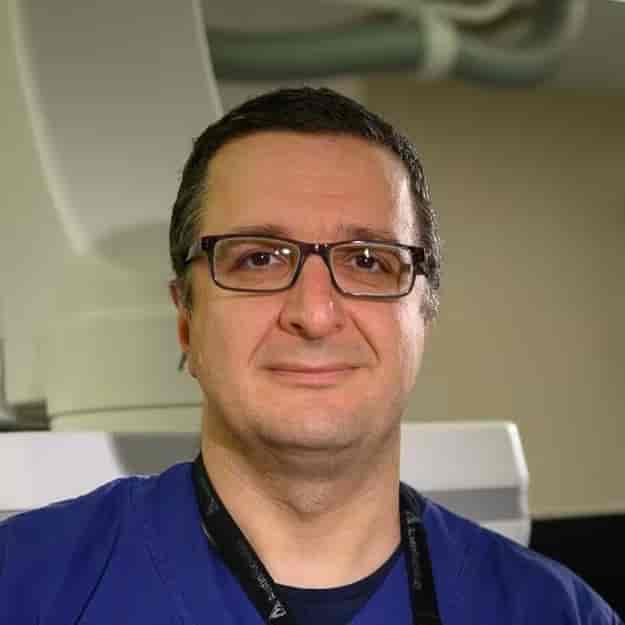
Profile picture of Dr. Hamed Asadi

Interventional Neuroradiologist

Australian Flag

Hamed Asadi

Icon representing available degree

MD, PhD, FRANZCR

Icon representing available city of this doctor

St Vincent's Hospital Melbourne Fitzroy

Connect with Hamed Asadi

Quick Appointment for Hamed Asadi

OPD Timings of Hamed Asadi

St Vincent's Hospital Melbourne (Fitzroy)

DayTime
SundayN/A
Monday8:00 AM–5:00 PM, By appointment
Tuesday8:00 AM–5:00 PM, By appointment
Wednesday8:00 AM–5:00 PM, By appointment
Thursday8:00 AM–5:00 PM, By appointment
Friday8:00 AM–5:00 PM, By appointment
SaturdayN/A

Services Offered by Hamed Asadi

  • Brain Aneurysm

  • Thrombectomy

  • Arteriovenous Malformation

  • Marchiafava Bignami Disease

  • Stent Placement

  • Stroke

  • Subarachnoid Hemorrhage

  • Vertebroplasty

  • Angioplasty

  • Aortic Dissection

  • Arterial Insufficiency

  • Ascites

  • Atherosclerosis

  • Bile Duct Obstruction

  • Bilirubin Encephalopathy

  • Brain Abscess

  • Bullae

  • Cardiac Ablation

  • Carotid Artery Disease

  • Cerebral Arteriovenous Malformation

  • Cerebrospinal Fluid Leak

  • Cholestasis

  • Congenital Coronary Artery Malformation

  • Coronary Artery Fistula

  • Corpus Callosum Agenesis

  • Endovascular Embolization

  • Familial Multiple Lipomatosis

  • Fractured Spine

  • Gastrostomy

  • Headache

  • Hemolytic Disease of the Newborn

  • Hemorrhoids

  • Liver Embolization

  • Low Blood Pressure

  • Peripheral Artery Disease

  • Portal Hypertension

  • Rathke Cleft Cyst

  • Spinal Tumor

  • Splenectomy

  • Splenic Infarction

  • Thoracic Aortic Aneurysm

  • Thrombophlebitis

About Of Hamed Asadi

I am Hamed Asadi, an interventional neuroradiologist based in Melbourne, Australia. I work across St Vincent’s Hospital, Austin Health, and Monash Health, and I hold a professorial appointment at Deakin University and the Florey Institute of Neuroscience and Mental Health.

My practice is almost entirely referral-based and procedure-focused: mechanical thrombectomy for acute stroke, endovascular treatment of cerebral aneurysms, arteriovenous malformations, dural fistulas, and spinal vascular lesions. I also perform diagnostic cerebral and spinal angiography when non-invasive imaging is inconclusive.

I completed my medical degree in Tehran, radiology training and FRANZCR at the Royal Melbourne Hospital, and a dedicated 18-month neurointerventional fellowship at Beaumont Hospital in Dublin—one of Europe’s highest-volume centres at the time. After a short period as consultant in Dublin, I returned to Melbourne in 2016 and have been in full-time public and private neurointerventional practice since.

Research and teaching are a large part of what I do. My PhD at the University of Melbourne was in neuroimaging, and I now supervise several PhD students. My lab concentrates on clinical applications of artificial intelligence in stroke and aneurysm care, outcome prediction modelling, and sustainable interventional practice. I have published more than 150 peer-reviewed papers and regularly speak at international meetings.

I am accredited by the Conjoint Committee (CCINR) in Australia and hold European boards in both interventional radiology (EBIR) and neurointervention (EBNI). I am a fellow of RANZCR and CIRSE.

Patients usually reach me through neurologists, neurosurgeons, or stroke physicians. My rooms do not run a traditional open clinic; consultations are arranged around planned procedures or urgent referrals. For professional contact, the most reliable routes are through the neurointerventional units at Austin, Monash, or St Vincent’s, or via Monash Neurovascular.

I remain driven by the fact that many of the conditions I treat can be cured or dramatically improved in a single procedure, often within hours of the patient arriving at hospital. That immediate translation of skill and technology into saved lives and preserved quality of life is what brought me to this subspecialty, and it still motivates me every day.

Education of Hamed Asadi

  • MD (Doctor of Medicine); Tehran University of Medical Sciences

  • PhD in Neuroimaging/Neuroscience; University of Melbourne

  • FRANZCR (Fellow of the Royal Australian and New Zealand College of Radiologists); Royal Melbourne Hospital

Memberships of Hamed Asadi

  • Fellow of the Royal Australian and New Zealand College of Radiologists (FRANZCR)

  • Registered by the Conjoint Committee for Recognition of Training in Interventional Neuroradiology, Australia (CCINR)

  • European Board of Interventional Radiology (EBIR)

  • Fellow of the Cardiovascular and Interventional Radiological Society of Europe (FCIRSE)

  • European Board of Neuro-Interventional Radiologists (EBNI)

  • Interventional Radiology Society of Australasia (IRSA) Directory Member

Experience of Hamed Asadi

  • Professor of Interventional Neuroradiology, Deakin University & Florey Institute of Neuroscience and Mental Health (Current, since ~2018)

  • Consultant Interventional Neuroradiologist, Austin Health, Melbourne (Current, since ~2016)

  • Consultant Interventional Neuroradiologist, Monash Health, Melbourne (Current, since ~2016)

  • Consultant Interventional Neuroradiologist, St Vincent's Hospital Melbourne, Fitzroy (Current, since ~2016)

  • Consultant Interventional Neuroradiologist, Beaumont Hospital, Dublin, Ireland (~2015-2016)

  • Advanced Fellowship in Interventional Neuroradiology, Beaumont Hospital, Dublin (~2013-2015)

Publications by Hamed Asadi

The "CUPCAKE" technique (coiled underlying pseudoaneurysm contained by a woven endobridge device) for treating intracranial aneurysms with atypical morphology.

Journal: Interventional neuroradiology : journal of peritherapeutic neuroradiology, surgical procedures and related neurosciences
Year: January 17, 2025
Authors: Viktorija Vainauskaite, Yifan Ren, Mohamed Nasra, Davor Pavlin Premrl, Sara Protto, Paul Siasat, Ali Khabaza, Ashu Jhamb, Christen Barras, Calvin Gan, Ronan Motyer, Paul Smith, Justin Moore, Jeremy Russell, Lee-anne Slater, Ronil Chandra, Mark Brooks, Winston Chong, Julian Maingard, Hamed Asadi

Description:Background: Intrasaccular flow diversion using the woven endobridge device (WEB; MicroVention, Aliso Viejo, CA, USA) for the treatment of intracranial aneurysms has demonstrated large scale safety and efficacy. However, limitations arise from its structural configuration, restricting its application to specific aneurysm sizes and shapes. We introduce the CUPCAKE technique, a combination of conventional coiling followed by WEB intrasaccular flow disruption in select cases of atypical aneurysms with technically challenging morphology not typically treatable by WEB alone. Methods: A retrospective analysis of a prospectively-maintained dataset from three Australian neurovascular tertiary referral centers, identifying patients treated with the CUPCAKE technique between April 2018 and September 2023. Evaluation of patient and aneurysm characteristics, procedure parameters, complications, radiological and clinical outcomes at follow-up was performed. Results: The CUPCAKE technique was used for the treatment of 22 intracranial aneurysms of total 169 treated with WEB. Overall successful immediate flow stagnation was observed in 95.5% (n = 21) of aneurysms with no cases of perforation or intraoperative hemorrhage. Imaging confirmed thromboembolic complications occurred in two patients, one patient had persistent flow requiring re-treatment during initial admission. Follow-up imaging demonstrated 88.2% complete aneurysm conclusion with no delayed aneurysm expansion or rupture. Conclusions: Synergistic use of conventional coiling with WEB intrasaccular flow disruption presents a viable solution for technically difficult aneurysm treatment. In our series, 13% of all patients treated with WEB received CUPCAKE treatment, resulting in high technical success and no increase in thromboembolic complications with the union of two methods.
Gender-Based Outcomes in Grants, Prizes and Fellowship Success Rates in Clinical Radiology: A 14-Year Review of Outcomes in Australia and New Zealand.

Journal: Journal Of Medical Imaging And Radiation Oncology
Year: June 19, 2025
Authors: Jack Liu, Lisa Milner, Behnam Shaygi, Michael Stewart, Anousha Yazdabadi, Julian Maingard, Hong Kok, Numan Kutaiba, Christen Barras, Paul Parizel, Hamed Asadi

Description:Background: While gender disparities in the radiology workforce are well-documented, there has been no analysis of outcomes for competitive awards in Australia and New Zealand. As formal recognition is critical for career progression, this study aimed to investigate gender-based differences in application and success rates for grants, prizes and educational fellowships within the Australasian context. Methods: We retrospectively reviewed applications for Royal Australian and New Zealand College of Radiologists' (RANZCR) Faculty of Clinical Radiology grants, prizes and educational fellowships from 2011 to 2024. Application and success rates were stratified by gender and compared to College membership demographics. Significance was assessed using Fisher's exact test. Results: Across 333 total applications, 227 (68.2%) were from males and 106 (31.8%) from females, closely reflecting College membership gender ratios (69.2% male vs. 30.8% female). No significant gender disparity was found in the success rates for grants (40.3% for males vs. 35.0% for females, p = 0.58), prizes (8.8% vs. 11.1%, p = 0.08) or educational fellowships (36.7% vs. 32.1%, p = 0.32). Application rates for each award type also broadly reflected the gender composition of the College membership. Conclusions: This study is the first to examine gender differences in clinical radiology grant, prize and educational fellowship outcomes in Australia and New Zealand. We found no significant disparities in success rates, and application rates generally mirrored College membership, suggesting the award process itself is equitable. However, the continued underrepresentation of women in radiology underscores the need to examine broader structural and sociocultural factors that may impact engagement with competitive academic opportunities.

Treatment of contrast induced encephalopathy: multicenter cohort study and proposed treatment algorithm.

Journal: Journal Of Neurointerventional Surgery
Year: April 21, 2025
Authors: Frederick Mariajoseph, Leon Lai, Adrian Praeger, Justin Moore, Ronil Chandra, Hamed Asadi, Peter Fawzy, Laetitia De Villiers, Tony Goldschlager, Albert Ho Chiu, Boaz Kim, Ferdinand Miteff, Ramon Martin Bañez, Davor Pavlin Premrl, Winston Chong, Robert Fang, Kate Mahady, Sophie Dunkerton, Brendan Steinfort, Bjoern Picker, Lee-anne Slater

Description:Background: Contrast induced encephalopathy (CIE) is an increasingly recognized but uncommon complication of endovascular procedures. Despite increased reports, there is limited evidence to guide clinical management. We sought to identify commonly used treatments for CIE and propose management strategies to aid clinical decision making. Methods: A retrospective multicenter study was conducted across 10 neurovascular centers in Australia. Cases were included based on previously proposed diagnostic criteria for CIE. Clinical features, treatments, and outcomes were extracted and analyzed. Descriptive statistics were used to characterize management strategies, and associations with clinical outcomes were assessed using Fisher's exact and χ2 tests. Results: 56 patients were identified (median age 65 years; 80.4% women). Common interventions included corticosteroids (66.1%), intravenous fluids (66.1%), and antiseizure medications (prophylactic 51.8% and therapeutic 12.5%). Half required intensive care admission for neurological monitoring. Complete recovery was achieved in 87.5% of cases. Corticosteroid administration was significantly associated with symptom resolution within 72 hours (OR 4.51, 95% CI 1.19 to 17.85, P=0.022), while intravenous fluids showed a non-significant trend toward shorter symptom duration (OR 2.25, 95% CI 0.64 to 8.15, P=0.170). Conclusions: CIE generally carries a favorable prognosis. Corticosteroids appeared to shorten symptom duration and may be considered in management. Based on our findings and the existing literature, we propose a treatment algorithm to guide clinicians. Prospective validation is warranted.

Nationwide multicenter experience of contrast-induced encephalopathy following neurointervention: clinical course and outcomes.

Journal: Journal Of Neurointerventional Surgery
Year: April 15, 2025
Authors: Frederick Mariajoseph, Leon Lai, Adrian Praeger, Justin Moore, Ronil Chandra, Hamed Asadi, Peter Fawzy, Laetitia De Villiers, Tony Goldschlager, Calvin Gan, Kevin Zhou, Albert Ho Chiu, Boaz Kim, Ferdi Miteff, Ramon Martin Bañez, Davor Pavlin Premrl, Winston Chong, Robert Fang, Kate Mahady, Sophie Dunkerton, Brendan Steinfort, Bjoern Picker, Lee-anne Slater

Description:Background: Contrast-induced encephalopathy (CIE) is an increasingly observed complication following neurointervention, but remains poorly defined with limited evidence for clinical decision-making. We sought to characterize the stereotypical clinical features of CIE in a nationwide, multicenter cohort. Methods: A multicenter cohort study was conducted between 10 neurovascular sites across Australia. Patients were screened according to the previously proposed Australian diagnostic criteria. Descriptive analysis was conducted to characterize the clinical course and outcomes of CIE, and associations between clinical and radiological variables on patient outcomes were analyzed using Fisher's exact and χ2 tests. Results: A total of 56 patients (median age 65 years) were included. The median contrast volume was 170 mL (IQR 140-229). Median time to symptom onset was 6 hours (IQR 1-12), with frequent symptoms including motor deficit (55.4%), dysphasia (39.3%), and confusion (35.7%). Common radiological findings included sulcal effacement (45.5%) and subarachnoid contrast staining (30.9%) on CT. Hemianopia (p=0.001) and cortical blindness (p=0.018) were associated with posterior circulation interventions, while motor deficit was correlated with anterior circulation interventions (p=0.001). At discharge, 87.5% of patients achieved complete resolution of symptoms, of which 69.4% achieved complete recovery within 72 hours. Conclusions: CIE is a recognized complication of neurointervention. Symptoms occur within hours of contrast administration and correlate with the territory of contrast administration. Most patients achieve complete symptom resolution. Ongoing investigation is required to further define CIE as a clinical entity.

Types of stent retrievers used in mechanical thrombectomy for acute ischaemic stroke: A scoping review.

Journal: Journal Of Clinical Neuroscience : Official Journal Of The Neurosurgical Society Of Australasia
Year: April 09, 2025
Authors: Jane Song, Kevin Zhou, Davor Pavlin Premrl, Ashu Jhamb, Calvin Gan, Ali Khabaza, Julian Maingard, Andrew Gauden, Lee-anne Slater, Justin Moore, Numan Kutaiba, Ronil Chandra, Anousha Yazdabadi, Mark Brooks, Hong Kok, Christen Barras, Hamed Asadi

Description:Mechanical thrombectomy using stent retrievers is the standard endovascular treatment for acute ischaemic stroke due to large vessel occlusion. With the rapid evolution in device design, this scoping review aims to map the current landscape of stent retriever types used in clinical practice, as well as their application across different sites of vessel occlusion. A comprehensive literature search was conducted using MEDLINE, Embase, and the Cochrane Central Register of Controlled Trials to identify primary studies reporting on the safety and efficacy of stent retrievers in mechanical thrombectomy for acute stroke. After screening and data extraction by two independent reviewers, 133 studies were included, encompassing 22 distinct stent retriever devices. Frequencies of thrombectomy procedures were analysed according to device type and occlusion location. The Solitaire and Trevo devices accounted for the majority of cases (57 %), with the most commonly treated occlusion sites being the M1 segment of the middle cerebral artery and the internal carotid artery (51 % and 19 %, respectively). In contrast, anterior cerebral artery and M3 or more distal occlusions were underrepresented, each comprising only 1 % of the data. This review highlights a strong evidence base for conventional stent retrievers in large vessel occlusions, particularly M1, while also revealing a significant gap in knowledge regarding newer generation stent retrievers and their use in distal medium vessel occlusions. Further research is needed to evaluate device safety and effectiveness in these smaller, more challenging vessels.

Frequently Asked Questions About Hamed Asadi

What conditions does Hamed Asadi treat as an Interventional Neuroradiologist?

Hamed Asadi specializes in treating conditions such as aneurysms, arteriovenous malformations, strokes, and other neurovascular disorders using minimally invasive procedures.

What are the common procedures performed by Hamed Asadi in interventional neuroradiology?

Hamed Asadi performs procedures such as cerebral angiography, embolization, thrombectomy, and carotid stenting to treat various neurovascular conditions.

How does Hamed Asadi approach patient care and treatment planning?

Hamed Asadi takes a multidisciplinary approach, working closely with neurosurgeons, neurologists, and other specialists to develop personalized treatment plans tailored to each patient's unique needs.

What are the benefits of choosing Hamed Asadi for interventional neuroradiology procedures?

Patients benefit from Hamed Asadi's expertise in minimally invasive techniques, which often result in shorter recovery times, reduced risk of complications, and improved outcomes compared to traditional surgery.

What should patients expect during a consultation with Hamed Asadi?

During a consultation, Hamed Asadi will review the patient's medical history, perform a physical examination, and discuss diagnostic tests to determine the most appropriate treatment options for their condition.

How can patients schedule an appointment with Hamed Asadi for interventional neuroradiology services?

Patients can schedule an appointment with Hamed Asadi by contacting his office directly or obtaining a referral from their primary care physician or specialist.
Toparrow